
Birmingham must turn its exceptional health, research and innovation assets into a globally recognised life sciences proposition, with government support and a clear long-term plan for the Birmingham Health & Life Sciences District (BHLSD), business and civic leaders have said.
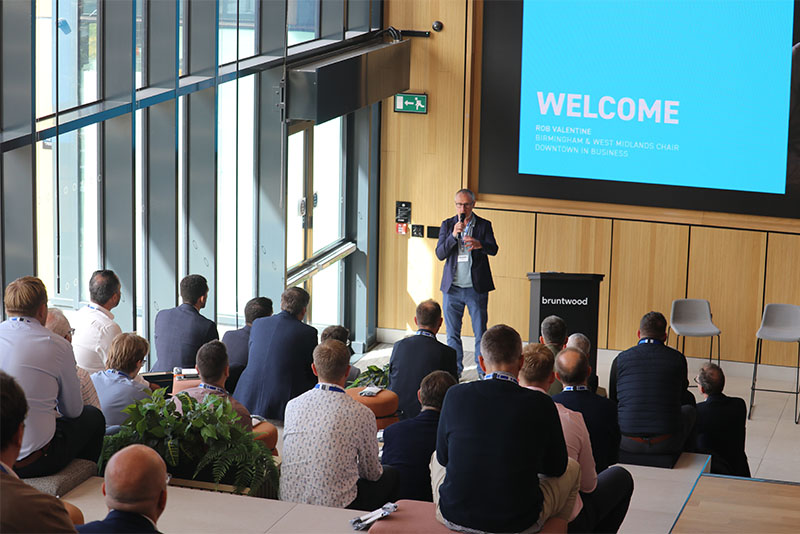
The call came from the Birmingham Innovation & Life Sciences Mini Conference, hosted by Downtown in Business at No.1 Birmingham Health Innovation Campus, which brought together senior figures from business, property, academia, healthcare, government and innovation to consider how Birmingham can translate its existing strengths into investment, jobs and economic growth.
Opening the event, Rob Valentine, Chair of Downtown in Business Birmingham & West Midlands, challenged Birmingham to be more ambitious about the assets it already possesses.
“All too often, we Brummies hide our light under a bushel. We talk about potential when much of what we need to become a genuinely world-class life sciences destination is already here.”
The foundations of a world-class hub already exist
The Birmingham Health & Life Sciences District is uniquely positioned around a combination of assets that few UK locations can replicate.
It brings together major university research, world-class clinical expertise, NHS infrastructure, a large and diverse patient population, emerging commercial activity and significant development opportunities – all within a highly connected urban district.
Crucially, BHLSD already has particular strengths in translational medicine, genomics, clinical trials and data-led healthcare.
The University of Birmingham has significant expertise in genomics and translational research, while the NHS has a major genetics presence within the district. Together with the city’s clinical infrastructure, diverse population and research base, these assets create the potential for Birmingham to become a major centre for taking discoveries from the laboratory, through clinical research, and into real-world treatments and commercial applications.
The opportunity, therefore, is not to manufacture a life sciences ecosystem from scratch.
It is to recognise what is already here, connect it properly and give it the scale, identity, infrastructure and investment framework needed to compete internationally.


BHLSD needs to become a proposition, not simply a collection of assets
Arcadis presented its emerging vision for the Birmingham Health & Life Sciences District, developed alongside the University of Birmingham, Bruntwood SciTech and Calthorpe Estates.
The work draws together extensive engagement across research, healthcare, academia and industry and identifies Birmingham’s strengths in clinical research, genomics, its diverse patient population, connectivity, affordability and development potential.
It also identifies the barriers preventing those assets from reaching their full potential – including fragmentation between organisations, insufficient external promotion, infrastructure requirements and the need to attract more major pharmaceutical and life sciences businesses.
The emerging proposition therefore focuses on moving from individual strengths to a coherent, investable district.
Recommendations include stronger leadership and a single ‘front door’ for investors, attracting anchor tenants and industry partners, improving data integration, developing a coordinated approach to talent and investment attraction, and ensuring the laboratory, digital, transport and wider infrastructure keeps pace with the needs of a modern life sciences economy.
But there is a bigger question for Birmingham and for government:
What do we ultimately want BHLSD to become?
At present, there is no sufficiently clear national or regional endgame for the district.
If Birmingham genuinely believes it can create a life sciences and translational medicine hub of international significance, then the district needs to be treated accordingly – with a clear identity, a long-term spatial vision, appropriate designation, infrastructure investment and a coordinated programme of public and private investment.


From ambition to action
Two panel discussions explored how Birmingham can convert this opportunity into investment and economic growth.
The first, “Birmingham’s Life Sciences Opportunity”, featured Neil Hanley of the University of Birmingham, Jessica Bowles of Bruntwood SciTech and Jamie Clyde of the West Midlands Growth Company.
The discussion examined how Birmingham can better connect its research, clinical, commercial and investment strengths and articulate a proposition capable of attracting international businesses, investors and talent.
A second panel, “From Ambition to Action”, brought together Jamie Bottomley of Track Real Estate, James Watts of Arup and Laura Sherliker of BondBryan:Fairhursts to explore the practical requirements around investment, infrastructure, property, policy and collaboration.
One recurring theme was the importance of proximity and place.
Bringing research, laboratories, clinical settings, businesses and investors together within a connected district can accelerate the journey from discovery to clinical application and ultimately commercialisation.
The built environment will need to keep pace. As genomics, precision medicine, targeted therapies and data-led healthcare develop, Birmingham will require flexible laboratory and innovation space, alongside the ability to adapt and repurpose existing buildings as the needs of the sector evolve.


Birmingham can turn the dial for UK plc
The conference also considered the wider economic opportunity.
Birmingham’s success in life sciences would not simply be a regional growth story. A genuinely successful BHLSD could help address one of the UK’s central economic challenges: how to convert the country’s world-class research and innovation base into higher levels of commercialisation, productivity, investment and high-value employment.
Simon Marks captured the scale of the opportunity:
“If you give us a billion, we will turn it into two. Birmingham is the place that really turns the dial for UK plc.”
That requires a change in mindset.
Birmingham should not be asking government to create something that does not exist. It should be asking government to back something that already has extraordinary foundations.
The city has the universities. It has the NHS. It has the clinical expertise. It has the research. It has genomics. It has a large and diverse population that can support research and clinical trials. It has developers, investors and innovation businesses. It has a major regeneration opportunity.
And it has BHLSD.
The task now is to join those pieces together and give them a common purpose.


Time to stop hiding our light
Rob Valentine said:
“All too often, we Brummies hide our light under a bushel. We have something here that has the potential to be genuinely world-class, particularly around translational medicine and genomics, and we need to start shouting about it.
“BHLSD already has many of the embedded assets that should make it one of the world’s leading research and development environments in these fields. The opportunity is to connect them, give the district a much clearer identity and create the conditions for businesses and research organisations to scale.
“But Birmingham cannot do this alone. Regional and national government need to get behind the opportunity. We need the ambition to match the assets we already have – including consideration of a special designation for the district, a clear long-term spatial and investment strategy, and, most importantly, an agreed endgame for what BHLSD is intended to become.
“If we get that right, the prize is much bigger than creating another successful sector in Birmingham. We can help drive the kind of high-value, innovation-led growth that UK plc desperately needs.
“The opportunity is sitting here. The challenge now is whether we have the ambition and collective determination to turn it into reality.”
The event formed part of Downtown in Business’ programme of activity bringing together decision-makers from across the public and private sectors to address the major opportunities and challenges facing Birmingham and the wider West Midlands.


